About MobileSignalBooster
Declan Harte
Founder & Editor-in-Chief
More than ten years tracking FCC certification cycles, carrier band changes, and the evolving landscape of consumer and commercial signal amplification products.
I got serious about this category the hard way. A family member moved to a rural property in the mid-2010s where two major carriers showed full bars on their coverage maps but delivered near-zero usable signal inside the house. I spent months reading every spec sheet, owner forum thread, and independent teardown I could find — trying to understand why some boosters transformed the situation and others barely moved the needle. What I discovered was that the information ecosystem around signal boosters was a mess: review sites either parroted manufacturer marketing copy or steered everyone toward the cheapest Amazon option regardless of their actual building type, carrier, or coverage goal. That gap became the reason this site exists.
What I bring to this site is a researcher's discipline applied to a genuinely technical category. Signal boosters sit at the intersection of RF engineering, FCC regulation, carrier policy, and consumer hardware — and most buyers encounter all four without realizing it. I've spent years reading the technical literature, FCC filings, carrier band-allocation updates, and the published engineering specs that determine whether a booster will actually solve your problem. I track how brands like Cel-Fi, Wilson Pro, and SureCall position their commercial lines differently from their consumer lines, and why that distinction matters when you're speccing a 10,000-square-foot warehouse versus a 1,200-square-foot apartment.
Every recommendation on this site is built from a consistent stack of sources: published gain and uplink/downlink power specs, FCC certification records, aggregated owner reports across verified-purchase reviews and enthusiast forums, and independent signal-measurement write-ups from RF hobbyists and telecom professionals. When owners consistently report that a particular unit drops performance in fringe-signal environments despite strong spec-sheet numbers, that pattern shapes the recommendation — even if the manufacturer's marketing says otherwise. The cost-per-use math also factors in: a $900 whole-home system that eliminates a dropped-call problem for a decade looks very different from a $150 unit that owners report degrading within two years.
What we refuse to do is flatten this category into a single price bracket or pretend that a $60 single-band booster is the answer for a rural farmhouse on 40 acres. We also refuse to recommend products based on affiliate commission rates rather than fit-for-purpose analysis. The premium and commercial-grade segment — Cel-Fi GO X for vehicles, Wilson Pro for business installs, weBoost Installed Home Complete for serious residential coverage — gets the same rigorous treatment as entry-level options, because those buyers are often the ones making the highest-stakes decisions and have been most poorly served by generic review sites chasing volume keywords. We call out products that reviewers rate poorly at scale, even when they carry strong brand recognition.
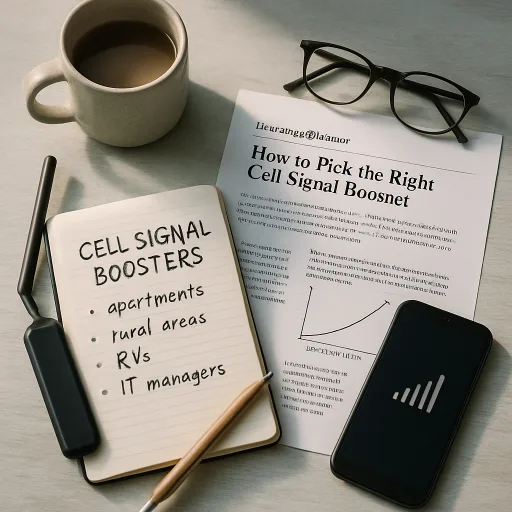
This site is written for anyone who has decided they are done tolerating bad signal and wants to understand what will actually fix it. That includes the apartment dweller trying to solve one dead corner on a budget, the remote worker whose rural home office depends on reliable LTE, the fleet manager evaluating vehicle boosters across dozens of trucks, and the IT director comparing distributed antenna options for a multi-floor office. The common thread is that these readers want analysis grounded in real specifications and aggregated owner experience — not a recycled top-five list that treats every situation as identical.